
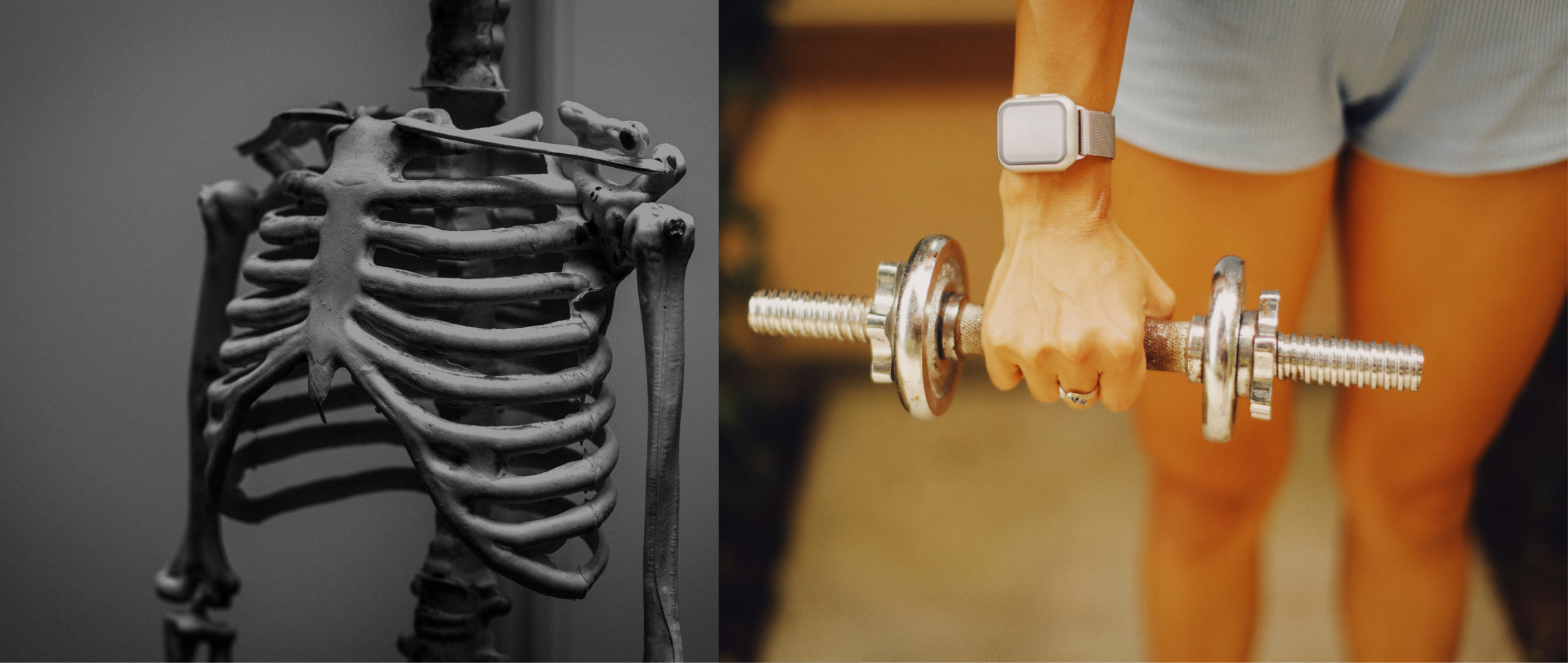
Your muscles and bones will let you know you’re in your 40s. It’s the creaking sounds your body now makes when you’re just trying to get off the couch. The random aches or pains that come out of nowhere. And it’s the fact that things like playing golf suddenly leave your muscles and bones feeling like you ran into Malibu on American Gladiators.
Muscle and bone get built on roughly the same timeline, peak around the same age, and start their slow decline together, too. So here’s what happens to strength and skeletal health in your 40s—and what the research says helps.
Muscle & strength: Metabolism-adjacent, but it starts earlier than you think
Hormones and metabolism are tied to the muscle loss that’s keeping you from dominating your rec softball league like you did a few years ago. Here’s how muscles, strength, and physical function change in your 40s.
1. Muscle loss starts around 30, not 40. By the time you hit 40, you’re already a decade into losing muscle. Most people drop roughly 3-5% every decade starting in their 30s, but some estimates run as high as 8%. The loss is slow and predictable—not a cliff you fall off in middle age (though it does accelerate in your 60s). Muscle loss’s gentle slope is an opportunity, because you can still actively push back against it with strength training. (Source: NIH News in Health, “Slowing Sarcopenia” (2025); Cleveland Clinic, “Sarcopenia.”)
2. Your explosive “power” muscle fibers fade first. Muscle fibers come in two broad types: slower endurance fibers (good for standing, walking, holding a plank) and fast-twitch fibers (the ones you use to sprint for a bus, catch yourself from a stumble, or do anything remotely athletic). Research shows that the fast-twitch power fibers shrink disproportionately with age and are more vulnerable than the endurance type. That’s a big reason explosive, quick movements often feel like the first thing to go with age, even when everyday stamina holds up fine. The fix isn’t complicated: fast-twitch fibers respond well to power-based, faster-tempo strength training. (Source: Nilwik et al., Experimental Gerontology (2013).)
3. Strength drops faster than muscle size does. It might be surprising that strength and muscle size don’t decline at the same rate. But strength drops about two to five times faster than muscle mass itself. In one tracking study, older adults lost about 16% of their knee-extending strength over five years while losing only about 5% of the actual thigh muscle. Since the muscle you have starts working less efficiently, not just getting smaller, your real goal isn’t just keeping your muscle, it’s keeping muscle you can use. (Source: Mitchell et al., Frontiers in Physiology (2012).)
4. Strength training can measurably slow the decline. Hopefully it’s reassuring to know that the process responds to effort, at any age, and one well-known study supports this. Researchers found that older adults, who started out about 59% weaker than younger adults, closed that gap to just 38% weaker after six months of twice-weekly resistance training. That’s a roughly 50% improvement in strength. That means you’re not fighting a losing battle against your body. You’re just working with a system that’s still capable of adapting as long as you give it a reason to. (Source: Melov et al., “Resistance Exercise Reverses Aging in Human Skeletal Muscle,” PLOS ONE (2007).)
Bones: What you built early, you’re now managing
Different tissue, but the same general theme as muscle: what you built in your 20s, you’re now maintaining rather than growing more as you age into your 40s and beyond.
5. Your skeleton peaked over a decade ago. By 40, most people’s bones have already started coasting past their lifetime high point. Peak bone mass is typically reached in the late 20s, with the majority built by the late teens and early 20s. After that, bone remodeling (the constant cycle of breaking down and building new bone) slowly tips toward slightly more breakdown than buildup. So your 40s aren’t when bones start failing, but it’s time to start paying a little more attention to what you’ve already got. (Source: National Institute of Arthritis and Musculoskeletal and Skin Diseases (NIAMS); Bone Health & Osteoporosis Foundation.)
6. Bone loss speeds up specifically around perimenopause. For most of the 30s and early 40s, bone loss in women is slow and unremarkable. Once perimenopause begins, declining estrogen changes the equation. Women can lose roughly 1-2% of bone density per year during this transition, and in some cases as much as 3-5% annually. The accelerated phase generally lasts about five years, meaning some women lose up to 20% of their bone density in total. Take this as a heads-up that the perimenopause years are a genuinely useful checkpoint to start bone-friendly habits. (Source: Mass General Brigham, “Menopause and Osteoporosis” (2024).)
7. A first bone scan isn’t usually on the table just yet. Despite the bone-loss chatter turning up around 40, doctors don’t typically recommend a first bone density (DEXA) scan at this age for most people. Current guidance points to 65 for women and 70 for men as the standard starting point for routine screening, per Mayo Clinic. Specific risk factors—early menopause, family history of osteoporosis, a prior fracture, or long-term steroid use—may move that timeline up. (Source: Mayo Clinic News Network, “Who Should Have a Bone Density Test?”)
8. You already know the exercises that protect bones. Bone responds to how you use it. Weight-bearing exercise—anything that makes you work against gravity, like brisk walking, jogging, dancing, stair climbing, or racquet sports—along with resistance training, signals bone to stay strong rather than drift toward loss. You don’t need a gym overhaul at 40, just consistent, moderate, weight-bearing movement most days. (Source: Cleveland Clinic, “8 Tips To Maintain Healthy Bones.”)
What actually helps your musculoskeletal system
Muscle and bone respond to the same basic input: resistance. Strength training two to three times a week—dumbbells, resistance bands, or bodyweight—is the single most evidence-backed option for both. Add faster-tempo or power-based moves (a quick step-up, a light jump, a fast push) to target the fast-twitch fibers that fade first. For bones, weight-bearing cardio—walking, dancing, stairs—rounds it out. None of this requires a full gym commitment. Also, consistently doing these exercises matters more than intensity.
Quick answers about changes in muscles and bones after 40
Why am I losing muscle in my 40s? Muscle loss actually starts around 30, not 40. Most people lose roughly 3-5% per decade starting during their 30s, and it accelerates after 65. By your 40s, you’re already a decade into a slow, predictable decline that strength training can measurably slow.
Can strength training reverse muscle loss? It can meaningfully slow and partly reverse it. In one study, older adults who did twice-weekly resistance training for six months cut their strength gap with younger adults roughly in half. The muscle-loss process responds to effort at any age.
When should I get a bone density test? Most people don’t need a first DEXA scan until 65 (women) or 70 (men), per Mayo Clinic. That’s unless specific risk factors—early menopause, family history of osteoporosis, a prior fracture, or long-term steroid use—move that timeline up.
What’s the best exercise for bone health in your 40s? Weight-bearing movements—like brisk walking, jogging, dancing, stair climbing, racquet sports—combined with resistance training. Both of these exercise approaches signal bone to stay strong rather than drift toward loss. And neither training tactic requires a major routine overhaul.
You aren’t falling apart just yet—at least not physically. So check out the big picture of what happens to your body in your 40s.
Disclaimer: This is general information, not medical advice — talk to a doctor about your specific symptoms, especially anything sudden or severe.
Sources & further reading
Muscle & strength
- • NIH News in Health, “Slowing Sarcopenia” (2025)
- • Nilwik et al., “The Decline in Skeletal Muscle Mass With Aging Is Mainly Attributed to a Reduction in Type II Muscle Fiber Size,” Experimental Gerontology (2013)
- • Mitchell et al., “Sarcopenia, Dynapenia, and the Impact of Advancing Age on Human Skeletal Muscle Size and Strength,” Frontiers in Physiology (2012)
- • Melov et al., “Resistance Exercise Reverses Aging in Human Skeletal Muscle,” PLOS ONE (2007)
Bones
- • NIAMS, “Osteoporosis in Men” (peak bone mass context); Bone Health & Osteoporosis Foundation
- • Mass General Brigham, “Menopause and Osteoporosis” (2024)
- • Mayo Clinic News Network, “Who Should Have a Bone Density Test?”
- • Cleveland Clinic, “8 Tips To Maintain Healthy Bones”